
Diploma In Medical Radio-diagnosis (DMRD)
What is Radio Diagnosis?
Radio diagnosis is a process that is used to create images of the human body or parts and also the function thereof for clinical purposes that also includes the study of normal anatomy and physiology.
Radio diagnosis course gives the individual an in-depth knowledge of how the field is vast and how the subjects in this field are covered thoroughly.
Candidates who have a keen interest and the willingness to learn about radiation and ultrasound should pursue this course and make a career in Radio diagnosis field. The individual needs to study the subjects thoroughly to get better at it.
After pursuing Radio diagnosis course, students may get the jobs as the lead medical image analyst, medical advisor, and radiographer. Students can pursue this course of Radio diagnosis as a bachelor's degree or master's degree according to their preference.
Highlights
The DMRD course is a postgraduate diploma course which can be taken by any MBBS graduate. It deals with the methods involved in radio diagnosis. The below table mentions the major course highlights for this course:
| Course Level | Postgraduate Diploma |
| Full-Form | Diploma in Medical Radio-Diagnosis |
| Duration | 2 years |
| Examination type | Semester based |
| Eligibility | MBBS degree with minimum marks scored being 50% and/or clearing the required entrance exam |
| Admission Process | Entrance or merit-based |
| Course Fee | INR 20,000-8,00,000 |
| Average Salary | INR 3-10 lakh |
| Top Recruiting Companies | Apollo, Medanta, Gleneagles, Silverline, Fortis, Hinduja Hospitals, etc. |
| Job Positions | Demonstrator, Medical Imaging Technologist, Nuclear Medicine Technologist, Professor Associate, Radiologic Technologist, Radiologist, Radiologist Assistant |
Benefits of Diploma in Medical Radio-diagnosis (D.M.R.D)
- Students will learn how to become professional radiologists, evaluate various diagnostic/interventional imaging investigations, and understand medical ethical and legal imaging elements in this course.
- Students will be able to more properly implement the numerous diagnostic approaches after completing this course, which will benefit them in their careers.
- It is advantageous for students who intend to pursue additional studies in this sector because it establishes their foundation.
- It is beneficial to get an understanding of radiation physics as it relates to radiology.
- Students understand the physical principles of radiography, picture quality, radiation protection, and the physical principles of image generation, etc.
- This course also offers individuals who are not particularly interested in this sector but want to enhance their abilities the opportunity to study.
- As this is a certificate programme, individuals can always pursue more education, such as a master's degree in radiology.
Future scopes of Diploma in Medical Radio-diagnosis (D.M.R.D)
Candidates interested in furthering their education can pursue M.D. and PhD degrees in this discipline. They can pursue a Master's degree in Radio Diagnosis. M.D. in Radiology, M.Tech. in Radio Frequency Communications Radio-Diagnosis, D.N.B. in Radiology, and other related degrees are available.
If the candidate obtains a PhD in Radiology, he will be eligible to seek a faculty job in Radiology at one of India's medical schools.
The demand for this course is likely to rise more in the future due to the increased use of technology in medical science.
Syllabus
DMRD course is designed for students to gain relevant knowledge & insights into radiology and Radiodiagnosis. The syllabus is well structured for students to provide comprehensive understanding through practical exercises, demonstrations, hands-on training, and case studies. DMRD job scopes provide significant career opportunities to students with various job roles.
Semester Wise DMRD Syllabus
DMRD syllabus meets the objectives and requirements of the students for the course as the subjects included in the course structure are extensive and help students to obtain relevant knowledge on radiology and related areas. The primary focus of the DMRD course is on laboratory technologies that have been used in recent years. DMRD course focuses on both the academic and practical components of the system.
The following is the DMRD course syllabus broken down by years:
First Year Syllabus
The table below contains the subjects in the first year of the DMRD Syllabus:
| Semester I | Semester II |
|---|---|
| Anatomy | Radiography and Processing Techniques |
| Pathology | Respiratory System |
| Radiology | X-Ray Machines & Accessories, Maintenance |
| Radiological Physics | X-ray Film / Image processing Techniques (Dark Room Techniques) |
Second Year Syllabus
The list of DMRD subjects for the second year is listed below:
| Semester III | Semester IV |
|---|---|
| Gastro-Intestinal and Pancreatic System | Ultrasound |
| Musculoskeletal system | CTC |
| Cardiovascular Radiology | Angiography |
| Neuro-Radiology | MRI |
Subjects
Diverse topics are covered by DMRD subjects, all of which are essential for candidates to comprehend during the duration of the two-year programme. Core and elective DMRD courses are divided into these two groups. Following is a list of DMRD Subjects:
Core Subjects
Students need to complete all core subjects over the course of several years in order to become specialists in the field. The DMRD subjects give students a thorough understanding of various medical and radiology specialities and expertise to aid in their significant career advancement. The following are some core DMRD subjects:
- Anatomy
- Pathology
- Radiology & Radiological Physics
- Gastro-Intestinal and Pancreatic System
- Musculoskeletal system
- Neuro-Radiology
- Cardiovascular Radiology
- Ultrasound
- CTC
- Angiography
- MRI
Elective Subjects
The DMRD syllabus contains a variety of elective subjects and specialisations in the course framework. The following is a list of the top elective subjects for DMRD.
- Clinical Radiology
- Practical Radiography
- Clinical Hematology
- Nuclear Medicine
- Clinical Microbiology
Course Structure
The DMRD syllabus is well-structured to give students a hands-on understanding of this sector. Core and elective studies are offered during the course of the two years. Students who work hard to finish this course will have bright futures. The typical course structure is listed below:
- VI Semester
- Core Subjects
- Elective Subjects
- Research Projects
- Presentation
Teaching Methodology and Techniques
The DMRD course curriculum considers the multiple approaches and procedures used in the medical industry as technology has advanced. The medical industry has recently embraced digital learning and practical experience with the various tools available in hospitals and laboratories. The following are some general teaching strategies:
- Lectures
- Class Participation
- Seminars
- Guest Lectures
- Group Discussion
- Practical Lab sessions
- Research-Based
Course Projects
The students are given DMRD course projects to help them build vital information and abilities for their future academic and professional success. Students receive practical experience and research for future growth through projects for DMRD courses. Popular DMRD course projects include
- Radiation Projection
- Ultrasound and Color Doppler
- MRI
- Digital Radiograph
- IVP, Fluoroscopy
- Mammography
- Elastography
- C.T. Scan
- Interventional Procedures
DMRD Course Books
DMRD books can help students comprehend basic ideas and learn about various topics based on their choices. Reference books are available for purchase, download, or loan from libraries. Here are a few of the most often-read DMRD books that are available to students:
| Name of Book | Author |
|---|---|
| Core Radiology | Jacob Mandell |
| Fundamentals of Diagnostic Radiology | Brant and Helms |
| Aids to Radiological Differential Diagnosis | Chapman & Nakielny |
| Radiology Review Manual | Wolfgang Dahnert |
Course Comparison
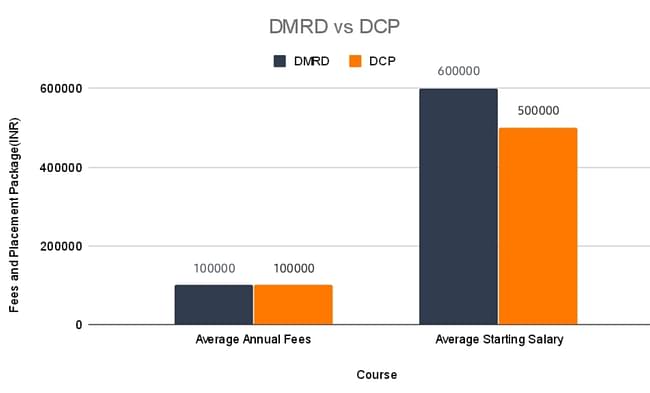
DMRD vs DCP
DMRD and DCP both are diploma courses, but DMRD deals with diagnostics through technology, while DCP deals with conventional pathological methods.
The major differences are elaborated in the table below:
| Parameters | DMRD | DCP |
|---|---|---|
| Course Level | Postgraduate Diploma | Postgraduate Diploma |
| Full-Form | Diploma in Medical Radio Diagnosis | Diploma in Clinical Pathology |
| Duration | 2 years | 2 years |
| Examination type | Semester based | Semester based |
| Eligibility | MBBS degree with minimum marks scored being 50% and/or clearing the required entrance exam | Graduate in MBBS/B.Sc. Biology |
| Admission Process | Entrance or merit based | Entrance exam and Merit Based |
| Course Fee | INR 20,000-8,00,000 | INR 10,000-8,00,000 |
| Average Salary | INR 3-10 lakh | INR 2-8 lakh |
| Top Recruiting Companies | Apollo, Medanta, Gleneagles, Silverline, Fortis, Hinduja Hospitals, etc. | Apollo Hospitals, All India Institute of Medical Sciences, Dr Lal Path Labs, Central Bureau of Investigation, etc. |
| Job Positions | Medical Imaging Technologist, Nuclear Medicine Technologist, Radiologic Technologist, Radiologist, Radiologist Assistant, Ultrasound Technician X-Ray Technician | Clinical Pathologist, Lab Executive, Clinical Manager, Pathologist, Medical Transcriptionist, Medical Examiner, Cytotechnologist, Mortuary Assistant, Dermatopathologist, Forensic Technician, Medical Lab Technician etc. |
Source: College Websites
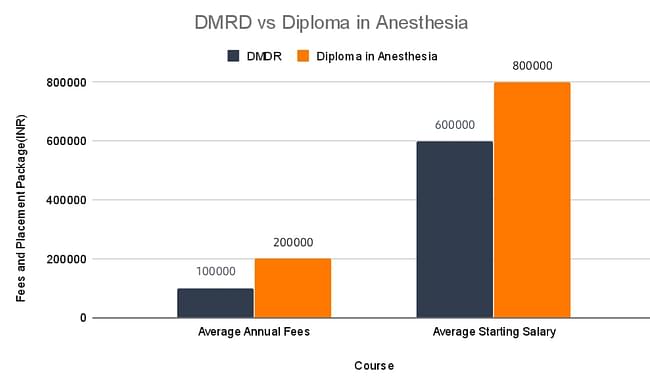
DMRD vs Diploma in Anesthesia
Anesthesia is a very important field which deals with anesthetic methods (making the patient senseless during an operation). The major difference between the two courses is elaborated in the table given below.
| Parameters | Radio Diagnosis | Anesthesia |
|---|---|---|
| Course Level | Postgraduate Diploma | Diploma |
| Full-Form | Diploma in Medical Radio Diagnosis | Diploma in Anesthesia |
| Duration | 2 years | 2 years |
| Examination type | Semester based | Semester based |
| Eligibility | MBBS degree with minimum marks scored being 50% and/or cleared the required entrance exam | Pass 10+2 examination in (PCB) with a minimum aggregate of 50% marks. |
| Admission Process | Entrance or merit based | Merit-Based |
| Course Fee | INR 20,000-8,00,000 | INR 42,000-15,00,000 |
| Average Salary | INR 3-10 lakh | INR 3-11 lakh |
| Top Recruiting Companies | Apollo, Medanta, Gleneagles, Silverline, Fortis, Hinduja Hospitals, etc. | Medanta, Sarvodaya, Geetanjali Hospitals, etc. |
| Job Positions | Medical Imaging Technologist, Nuclear Medicine Technologist, Radiologic Technologist, Radiologist, Radiologist Assistant, Ultrasound Technician, X-Ray Technician | Radiologist, Anesthetist, Medical Consultant, Paediatrician |
DMRD Top Colleges
Diploma in Medical Radio Diagnosis [DMRD] Top Colleges
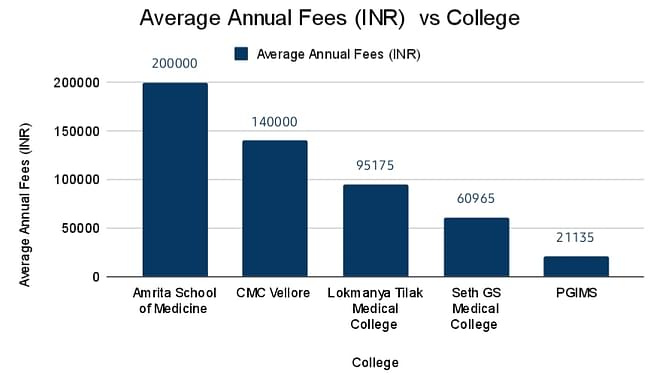
The top government and private colleges providing Diploma in Medical Radio Diagnosis are tabulated in the table below:
| India Today Rankings | College Name | City | Admission Process | Average Annual Fee (INR) |
|---|---|---|---|---|
| 2 | Christian Medical College | Vellore | Merit-based | 1,40,000 |
| 11 | Seth GS Medical College | Mumbai | Entrance-based | 60,965 |
| 13 | Bangalore Medical College and Research Institute | Bangalore | Entrance-based | 20,000 |
| 14 | St. John’s Medical College | Bangalore | Entrance-based | 5,00,000 |
| 17 | Lokmanya Tilak Municipal Medical College | Mumbai | Entrance-based | 95,175 |
| 31 | Amrita School of Medicine | Kochi | Entrance-based | 2,00,000 |
| 32 | Pt Bhagwat Dayal Sharma Post Graduate Institute of Medical Science | Rohtak | Entrance-based | 21,153 |
College Comparison
The top colleges offering DMRD are compared in detail in the table given below:
| Parameter | Christian Medical College | Seth GS Medical College | Amrita School of Medicine |
|---|---|---|---|
| Overview | CMC Vellore is a private institute, established in 1900 and affiliated to The Tamil Nadu Dr. MGR Medical University. | Seth Gordhandas Sunderdas Medical College is a private institution affiliated to Maharashtra University of Health Sciences. | Amrita School of Medicine, Kochi is a private medical college established in 2002 and is affiliated to Amrita Vishwa Vidyapeetham, Kochi. |
| Rank (India Today) | 2 | 11 | 31 |
| City | Vellore | Mumbai | Kochi |
| Eligibility | MBBS degree with minimum marks scored being 50% | MBBS degree with minimum marks scored being 50% and cleared the NEET-PG | MBBS degree with minimum marks scored being 50% and cleared the NEET-PG |
| Admission Criteria | Merit-based | Entrance-based | Entrance-based |
| Average Fees | INR 1,40,000 | INR 60,965 | INR 2,00,000 |
| Placement companies | The hospital affiliated to each of its colleges recruits its students. | Apollo, KEM, TCS, Cognizant etc. | Any hospitals worldwide or abroad |
Diploma In Medical Radio Diagnosis (DMRD) Admission Process
Admission To The DMRD Course Is Mostly Merit-based. But Many Colleges Or Private Institutions Require Entrance Exams Like NEET PG, AIAPGET, PGI, Etc. Hence The Admission Procedure May Differ Slightly For Both Types Of Admissions.
Merit-Based
- The Application Process Is Completely Online On The Website Of The Respective College.
- Students Must Register Themselves On The Link Provided On The Website. It Is Preferable To Create An Email Id If The Student Does Not Have One As Most Of The Communication Will Be Done Through Email.
- Submit Scanned Copies Of All Required Documents Such As Mark-sheets, Id Proofs, Caste/Migration/Transfer Certificate, Etc.
- The Candidate Has To Pay The Application Fee Online Which Varies From College To College.
- After The Application Fee Has Been Submitted, The Application Process Is Complete. The College Will Put Up A Merit List Post When All Applications Have Been Completed. The Admission Fee Is Confirmed After The Students That Have Their Names In The Merit List Pay The Admission Fees.
Entrance-Based
- Post The Announcement Of The Results Of The Required Entrance Exam, Students Can Apply To Colleges Through The Central/State Counseling Process.
- The Official Website Of The Medical Council Of India (MCI) Uploads The Link For The Counseling Where Students Have To Register Themselves To Be A Part Of The Process.
- The Candidates Will Be Emailed Their Allotment Letters For The Colleges They Desire To Be In And Have Qualified For.
- The Admission Will Be Confirmed Only After The Payment Of Admission Fees To The College.
Eligibility Criteria For Diploma In Medical Radio-diagnosis (DMRD)
- Students Who Have Obtained An M.B.B.S. Degree With A Minimum Of 50% Aggregate Marks From A Recognised University Or College Can Register For This Programme.
- As A Selection Factor, Several Colleges Prefer Admission Exam Scores.
- Candidates Must Also Be In Good Health And Pass The Medical Exam.
- Admission To The D.M.R.D. The Programme Is Largely Based On Merit. However, Many Colleges And Private Institutions Require Entrance Tests Like NEET-PG, A.I.A.P.G.E.T., P.G.I., And Others
Diploma In Medical Radio Diagnosis (DMRD) Entrance Exams
Most Of The Top Colleges Prefer To Take Admission Through Entrance Exams. Some Of The Most Popular Entrance Exams Are Tabulated In The Table Below:
NEET PG
AIAPGET
MH PGM PGD CET
*There May Be Changes In The Exam Dates And Result Announcements Due To The COVID-19 Pandemic Scenario.
How To Prepare For These Entrance Exams?
- All These Entrance Exams Contain Multiple-choice Questions Based On The Subjects That Have Been Taught In The MBBS Degree Course.
- These Exams Have A Marking Scheme That Awards Students 4 Marks For A Right Answer And A Minus One Mark For A Wrong Answer. Hence, Students Must Put In Practice To Not Mark The Answers To Which They Are Not 100% Sure Of.
- Focus On Your Weak Subjects And Keep Making Notes For Revision.
- Solve As Many Questions As You Can With A Timer So You Can Determine Your Speed To Solve Questions Related To Particular Subjects And Properly Manage Time During The Examination.
How to Prepare?
- Start early. The DMRD exam is a challenging exam, so it is important to start preparing early. Give yourself plenty of time to study the material and to practice answering questions.
- Create a study plan. Once you know when the exam is, create a study plan that will help you stay on track. Make sure to include time for both reviewing the material and practicing answering questions.
- Find a good study guide. There are many good study guides available for the DMRD exam. Find one that is comprehensive and that covers all of the material that you need to know.
- Take practice exams. Once you have a good understanding of the material, start taking practice exams. This will help you get used to the format of the exam and to the types of questions that are asked.
- Get enough sleep the night before the exam. It is important to get a good night's sleep before the exam. This will help you stay alert and focused during the exam.
- Eat a healthy breakfast on the day of the exam. Eating a healthy breakfast will give you the energy that you need to focus during the exam.
- Arrive early for the exam. This will give you time to relax and to review your notes before the exam begins.
- Stay calm during the exam. It is normal to feel nervous during the exam. However, it is important to stay calm and to focus on the task at hand.
- Don't give up. The DMRD exam is a challenging exam, but it is possible to pass. If you feel like you are struggling, take a deep breath and keep going.
Here are some additional tips that may be helpful:
- Join a study group. Studying with other people can help you stay motivated and on track.
- Find a mentor. A mentor can provide guidance and support as you prepare for the exam.
- Take advantage of online resources. There are many online resources available that can help you prepare for the DMRD exam.
Career Opportunities After Diploma In Medical Radio-diagnosis (DMRD)
A Candidate Who Completes This Degree Is Eligible For Various Private And Government Positions In All Indian Hospitals And Medical Institutes. Aside From This, Individuals Can Find Work In India's Numerous Diagnostic Clinics. Even After Completing This Course, You Can Create Your Imaging Centre. The Diagnostics Department Has Transformed Due To Urbanisation And Technological Advancements, And It Has Become A Large Profitable Business In The Economy. Radiology Procedures Are Used In Almost All Private Nursing Facilities. As A Result, Candidates Can Also Work In These Nursing Facilities.
Medical Imaging Technologist, X-Ray Technician, And Ultrasound Technician Are Among The Different Job Profiles. Professor Associate, Radiologist, Radiologist Assistant, Nuclear Medicine Technologist, Radiologic Technologist, Demonstrator, Professor Associate, Radiologist, Radiologist Assistant One Can Work In A Variety Of Industries And Hospitals, Including Corporate, Super-speciality, Multi-speciality, Industrial, Or Private Clinics, Or With The N.D.A. Force Health Care. The Typical D.M.R.D. Pay Ranges From INR 3 To 10 Lakh Per Year.
DMRD: Why This Course
- The Course Provides The Students With Skills To Become A Professional Radiologist And Interpret Various Diagnostic/interventional Imaging Studies And Be Versed With Medical Ethics And Legal Aspects Of Imaging.
- After Taking This Course, Students Will Be Able To Implement The Various Diagnostic Methods More Accurately Which Will Help Them In Their Career.
- It Is Beneficial For Students Who Wish To Study Further In This Field As It Creates A Base For It.
- It Is Of Assistance To Acquire Knowledge Of Radiation Physics Related To Radio-diagnosis, Radiography, Image Quality, And Radiation Protection And To Cognize The Physical Principles, Image Formation Etc.
- As This Is A Diploma Course, So The Candidates Can Always Go For Higher Studies Like MS In Radiology.
- Also, This Course Provides An Opportunity Of Learning To Those Candidates Who Are Not Deeply Interested In This Field, But Want To Learn To Improve Their Skills.
Required Skillets For Radio Diagnosis
There Are Certain Skill Sets Which Are Required To Be Possessed By The Individuals Working In Radio Diagnosis to Enhance Themselves. Some Of The Required Skill Sets Are:
Communication Skills - The Individual Needs To Have This Skill As They Need To Convey The Results To The Patients In A Way That The Patient Should Also Understand What The Individual Is Trying To Say. He/she Should Be Able To Present The Information.
Logical Abilities: The Individual Should Have Logical Abilities To Use The Information From The Data That Is Collected And Then Identify The Problem. They Should Determine The Radio Diagnosis And Also Suggest The Treatment That Should Be Given To The Individual.
Interpersonal Skill - The Individual Should Possess This Skill As They Are Required To Have Interaction With The Patient. They Should Have A Very Calm And Relaxing Manner To Put The Patient At Ease.
Technical Skills - The Individual Should Be Ready To Learn And Also Stay Updated About The Evolving Range Of Diagnostic Imaging Equipment And Also How To Use Them, Which Is Very Crucial In This Field.
Who Should Pursue a DMRD Course?
Medical professionals can pursue DMRD after MBBS. Students can opt for DMRD after BHMS or BAMS. Students looking to gain knowledge and relevant expertise in the field of radiology and radio diagnosis can pursue this course.
When To Do DMRD Course?
The MBBS degree or an equivalent test must be passed with a minimum overall score of 50% to qualify for DMRD admission. Those possessing a medical degree and a permanent registration certificate from MCI of India are eligible for the course.
Diploma In Medical Radio Diagnosis (DMRD) Admission Process
Admission To The DMRD Course Is Mostly Merit-based. But Many Colleges Or Private Institutions Require Entrance Exams Like NEET PG, AIAPGET, PGI, Etc. Hence The Admission Procedure May Differ Slightly For Both Types Of Admissions.
Merit-Based
- The Application Process Is Completely Online On The Website Of The Respective College.
- Students Must Register Themselves On The Link Provided On The Website. It Is Preferable To Create An Email Id If The Student Does Not Have One As Most Of The Communication Will Be Done Through Email.
- Submit Scanned Copies Of All Required Documents Such As Mark-sheets, Id Proofs, Caste/Migration/Transfer Certificate, Etc.
- The Candidate Has To Pay The Application Fee Online Which Varies From College To College.
- After The Application Fee Has Been Submitted, The Application Process Is Complete. The College Will Put Up A Merit List Post When All Applications Have Been Completed. The Admission Fee Is Confirmed After The Students That Have Their Names In The Merit List Pay The Admission Fees.
Entrance-Based
- Post The Announcement Of The Results Of The Required Entrance Exam, Students Can Apply To Colleges Through The Central/State Counseling Process.
- The Official Website Of The Medical Council Of India (MCI) Uploads The Link For The Counseling Where Students Have To Register Themselves To Be A Part Of The Process.
- The Candidates Will Be Emailed Their Allotment Letters For The Colleges They Desire To Be In And Have Qualified For.
- The Admission Will Be Confirmed Only After The Payment Of Admission Fees To The College.
Eligibility Criteria For Diploma In Medical Radio-diagnosis (DMRD)
- Students Who Have Obtained An M.B.B.S. Degree With A Minimum Of 50% Aggregate Marks From A Recognised University Or College Can Register For This Programme.
- As A Selection Factor, Several Colleges Prefer Admission Exam Scores.
- Candidates Must Also Be In Good Health And Pass The Medical Exam.
- Admission To The D.M.R.D. The Programme Is Largely Based On Merit. However, Many Colleges And Private Institutions Require Entrance Tests Like NEET-PG, A.I.A.P.G.E.T., P.G.I., And Others
Diploma In Medical Radio Diagnosis (DMRD) Entrance Exams
Most Of The Top Colleges Prefer To Take Admission Through Entrance Exams. Some Of The Most Popular Entrance Exams Are Tabulated In The Table Below:
NEET PG
AIAPGET
MH PGM PGD CET
*There May Be Changes In The Exam Dates And Result Announcements Due To The COVID-19 Pandemic Scenario.
How To Prepare For These Entrance Exams?
- All These Entrance Exams Contain Multiple-choice Questions Based On The Subjects That Have Been Taught In The MBBS Degree Course.
- These Exams Have A Marking Scheme That Awards Students 4 Marks For A Right Answer And A Minus One Mark For A Wrong Answer. Hence, Students Must Put In Practice To Not Mark The Answers To Which They Are Not 100% Sure Of.
- Focus On Your Weak Subjects And Keep Making Notes For Revision.
- Solve As Many Questions As You Can With A Timer So You Can Determine Your Speed To Solve Questions Related To Particular Subjects And Properly Manage Time During The Examination.
How to Prepare?
- Start early. The DMRD exam is a challenging exam, so it is important to start preparing early. Give yourself plenty of time to study the material and to practice answering questions.
- Create a study plan. Once you know when the exam is, create a study plan that will help you stay on track. Make sure to include time for both reviewing the material and practicing answering questions.
- Find a good study guide. There are many good study guides available for the DMRD exam. Find one that is comprehensive and that covers all of the material that you need to know.
- Take practice exams. Once you have a good understanding of the material, start taking practice exams. This will help you get used to the format of the exam and to the types of questions that are asked.
- Get enough sleep the night before the exam. It is important to get a good night's sleep before the exam. This will help you stay alert and focused during the exam.
- Eat a healthy breakfast on the day of the exam. Eating a healthy breakfast will give you the energy that you need to focus during the exam.
- Arrive early for the exam. This will give you time to relax and to review your notes before the exam begins.
- Stay calm during the exam. It is normal to feel nervous during the exam. However, it is important to stay calm and to focus on the task at hand.
- Don't give up. The DMRD exam is a challenging exam, but it is possible to pass. If you feel like you are struggling, take a deep breath and keep going.
Here are some additional tips that may be helpful:
- Join a study group. Studying with other people can help you stay motivated and on track.
- Find a mentor. A mentor can provide guidance and support as you prepare for the exam.
- Take advantage of online resources. There are many online resources available that can help you prepare for the DMRD exam.
Career Opportunities After Diploma In Medical Radio-diagnosis (DMRD)
A Candidate Who Completes This Degree Is Eligible For Various Private And Government Positions In All Indian Hospitals And Medical Institutes. Aside From This, Individuals Can Find Work In India's Numerous Diagnostic Clinics. Even After Completing This Course, You Can Create Your Imaging Centre. The Diagnostics Department Has Transformed Due To Urbanisation And Technological Advancements, And It Has Become A Large Profitable Business In The Economy. Radiology Procedures Are Used In Almost All Private Nursing Facilities. As A Result, Candidates Can Also Work In These Nursing Facilities.
Medical Imaging Technologist, X-Ray Technician, And Ultrasound Technician Are Among The Different Job Profiles. Professor Associate, Radiologist, Radiologist Assistant, Nuclear Medicine Technologist, Radiologic Technologist, Demonstrator, Professor Associate, Radiologist, Radiologist Assistant One Can Work In A Variety Of Industries And Hospitals, Including Corporate, Super-speciality, Multi-speciality, Industrial, Or Private Clinics, Or With The N.D.A. Force Health Care. The Typical D.M.R.D. Pay Ranges From INR 3 To 10 Lakh Per Year.
DMRD: Why This Course
- The Course Provides The Students With Skills To Become A Professional Radiologist And Interpret Various Diagnostic/interventional Imaging Studies And Be Versed With Medical Ethics And Legal Aspects Of Imaging.
- After Taking This Course, Students Will Be Able To Implement The Various Diagnostic Methods More Accurately Which Will Help Them In Their Career.
- It Is Beneficial For Students Who Wish To Study Further In This Field As It Creates A Base For It.
- It Is Of Assistance To Acquire Knowledge Of Radiation Physics Related To Radio-diagnosis, Radiography, Image Quality, And Radiation Protection And To Cognize The Physical Principles, Image Formation Etc.
- As This Is A Diploma Course, So The Candidates Can Always Go For Higher Studies Like MS In Radiology.
- Also, This Course Provides An Opportunity Of Learning To Those Candidates Who Are Not Deeply Interested In This Field, But Want To Learn To Improve Their Skills.
Required Skillets For Radio Diagnosis
There Are Certain Skill Sets Which Are Required To Be Possessed By The Individuals Working In Radio Diagnosis to Enhance Themselves. Some Of The Required Skill Sets Are:
Communication Skills - The Individual Needs To Have This Skill As They Need To Convey The Results To The Patients In A Way That The Patient Should Also Understand What The Individual Is Trying To Say. He/she Should Be Able To Present The Information.
Logical Abilities: The Individual Should Have Logical Abilities To Use The Information From The Data That Is Collected And Then Identify The Problem. They Should Determine The Radio Diagnosis And Also Suggest The Treatment That Should Be Given To The Individual.
Interpersonal Skill - The Individual Should Possess This Skill As They Are Required To Have Interaction With The Patient. They Should Have A Very Calm And Relaxing Manner To Put The Patient At Ease.
Technical Skills - The Individual Should Be Ready To Learn And Also Stay Updated About The Evolving Range Of Diagnostic Imaging Equipment And Also How To Use Them, Which Is Very Crucial In This Field.
Who Should Pursue a DMRD Course?
Medical professionals can pursue DMRD after MBBS. Students can opt for DMRD after BHMS or BAMS. Students looking to gain knowledge and relevant expertise in the field of radiology and radio diagnosis can pursue this course.
When To Do DMRD Course?
The MBBS degree or an equivalent test must be passed with a minimum overall score of 50% to qualify for DMRD admission. Those possessing a medical degree and a permanent registration certificate from MCI of India are eligible for the course.