
Diploma In X-ray Tehnology(D X-ray T)
Diploma in X-Ray Technology: What is it About?
Diploma in xray technology is a 2 year professional course pursued by students after completing 10+2. This course imparts knowledge about the techniques and methods used to operate the machines used in radiographic or x ray of human body and also helps in developing the skill needed in conducting lab tests, x ray, electrocardiograms. Students pursuing this course get vast knowledge about ultrasound, CT scan, magnetic resonance, computer tomography etc. Not only this, but also about diagnosing and finding ailments or diseases in the body.
Candidates interested in pursuing this course are granted admission directly or by qualifying an entrance exam conducted at State or University level. It must be noted that candidates must have passed 10+2 with a minimum of 45% with Science stream from a recognized university. Some students also pursue higher studies after doing the diploma course.
After successful completion of the diploma course, each candidate gets the opportunity to make career in medical fields such as hospitals, clinics, x ray centers, nursing homes, educational institutes etc. The requirement for skilled x ray technician is rapidly growing and will continue to grow with the growth in medical sector. X ray technicians are skilled individuals who possess both clinical skills as well as administrative skills. The diploma holders get both the options either to apply for a job or pursue bachelor’s and master’s degree further.
The healthcare industry is expanding and professionals in various fields are needed to ensure a well-managed healthcare sector in a country.
- This course deals with the electromagnetic radiations that enter the human body and create images of internal structures in photographic film. After the doctor deals with the problem and treats them.
- This course helps the students to acquire the knowledge to perform in the laboratory tests, general radiography and electrocardiograms and many more tests with the technology of electromagnetic radiations.
- Diploma in X-ray technology is a course where students can learn how to prepare a patient undergoing X-rays and electrocardiogram procedures and the process is carried out carefully.
- Students conduct veni-punctures and injections as well as office laboratory tests.
- Radiology has its important in the growing medical sciences field. The rapid growth of imaging technology over the last few years has opened up several opportunities in radiology and scanning. The Radiology course after 12th offers the study of imaging and radiography techniques used for diagnosis and treatment purposes. Plenty of radiology techniques have evolved from X-rays, and the course work offers a detailed study of the functioning of all state-of-the-art scanning technologies.
Highlights
| Course Name | Diploma in X-ray Technology |
| Course level | Undergraduate Degree. |
| Duration | 2 years. |
| Examination Type | Semester. |
| Eligibility | 12th completion. |
| Admission Process | Entrance exam based / Merit based. |
| Course Fee | Between INR 2 to 3 LPA. |
| Average Starting Salary | INR 3,00,000 |
| Top Recruiting Companies | Hospitals, Clinics, Medical labs, Govt. Hospitals etc. |
| Job Positions | X-ray technician, Assistant X-ray Technician, Radiologist, Teacher etc. |
Semester Wise Diploma in X-Ray Technology Syllabus
The students who have chosen Diploma in X-Ray Technology are the ones who are going to be professionals in the related critically examine, and perform laboratory related diagnosis.
A Diploma in X-Ray Technology course consists of a curriculum that includes studying various facets of X-Rays.
Diploma in X-Ray Technology First Year Syllabus
The table below contains the list of Diploma in X-Ray Technology Subjects in the first year:
| Semester I | Semester II |
|---|---|
| Human Anatomy and Physiology | Electrocardiography |
| Basic Of Radiotherapy | Radiography: Patient Care and Hospital Practice |
| Radiographic Techniques and Diagnostic | Radiodiagnostic Radiography Equipment |
Diploma in X-Ray Technology Second Year Syllabus
The table below contains the list of Diploma in X-Ray Technology Subjects in the Second year:
| Semester III | Semester IV |
|---|---|
| Radiodiagnostic Result Correlation | Radiographic Techniques |
| Clinical Hematology, Chemistry, and Urinalysis | Basic Physics |
| Diagnostic Radiography | Radiographic Image Acquisition. |
Diploma in X-Ray Technology Subjects
The Diploma in X-Ray Technology courses specialization is one of the best on its own. This course focuses on practical research based tests so there are no elective subjects in this course. Only core subjects are there for the students who have enrolled themselves in this Diploma in X-Ray Technology course.
Core subjects are the important ones that make the syllabus more worthy and valuable.
Diploma in X-Ray Technology Core Subjects
The core Diploma in X-Ray Technology Subjects list contains essential subjects that all Diploma in X-Ray Technology students study irrespective of their specialization, which is as follows:
- Human Anatomy and Physiology
- Radiographic Techniques and Diagnostic
- Electrocardiography
- Radiography
- Physics
Diploma in X-Ray Technology Course Structure
The Diploma in X-Ray Technology Course structure consists of only core subjects. The course is a two-year-long diploma course, divided into two semesters. From the first semester onwards, students are introduced to specific important subjects related to their specialization. The course structure is:
- IV Semesters
- Core Subjects
- Diploma Course
- Project and Assignments
- Research Concepts
Diploma in X-Ray Technology Teaching Methodology and Techniques
A Diploma in X-Ray Technology Course has some important teaching methodology that creates a practical and theoretical awareness of the learner. A perfect environment is given to the students where they can ask their doubts comfortably without any hesitation.
The Diploma in X-Ray Technology Teaching techniques are all about giving the best possible knowledge at their best facilities.
Listed below are the teaching methodology and strategies in general:
- Lectures
- Practical Sessions
- Seminars
- Group Discussions
- Traditional Classroom-based Teaching
Diploma in X-Ray Technology Projects
While pursuing a Diploma in X-Ray Technology Program, course projects and assignments related to the specialization are essential parts of the studies.
The projects are there in the course of the Diploma in X-Ray Technology to check whether the students are getting understood or not.
The students are given the option to choose the projects according to their interests. Listed below are some of the popular projects:
- Role of diffusion magnetic resonance imaging in the assessment of neoplastic and inflammatory brain lesions
- Radiological spectrum of chest diseases in HIV-infected children High-resolution ultrasonography in neck masses in children
- Role of ultrasonography in the diagnosis of knee joint lesions
- Role of ultrasonography in the evaluation of various causes of pelvic pain in the first trimester of pregnancy.
Diploma in X-Ray Technology Books
While pursuing any course like Diploma in X-Ray Technology, books are the biggest support of the students as they really stand as a pillar of knowledge in their specialization. Diploma in X-Ray Technology Course books are a source of information for the students from where they can attain a lot more information about their topic of interest.
Libraries give access to the students for taking any books on rent. There is also an option available for downloading books online.
Listed below are some of the popular Diploma in X-Ray Technology Course books that the students can invest in:
| Name Of Book | Author |
|---|---|
| Human Anatomy and Physiology | Elaine Nicpon Marieb |
| Basic Of Radiotherapy | David S. Chang, Foster D. Lasley, Indra J. Das, Marc S. Mendonca |
| Radiographic Techniques and Diagnostic | Professor J. H. Middlemiss |
| Radiographic Image Acquisition. | Terri Fauber |
Top Colleges
Some of the Top Diploma In X-ray Technology institutes in India is given below :
| Name Of The College | Average Annual Fees |
|---|---|
| NIMS University, Jaipur | INR 35,000 |
| RKDF University, Bhopal | INR 28,000 |
| Academy Allied Health Sciences, Kolkata | INR 33,000 |
| Glocal University, Saharanpur | INR 79,000 |
| NIU, Greater Noida | INR 52,000 |
| Hind Institute Of Medical sciences, Lucknow | INR 60,000 |
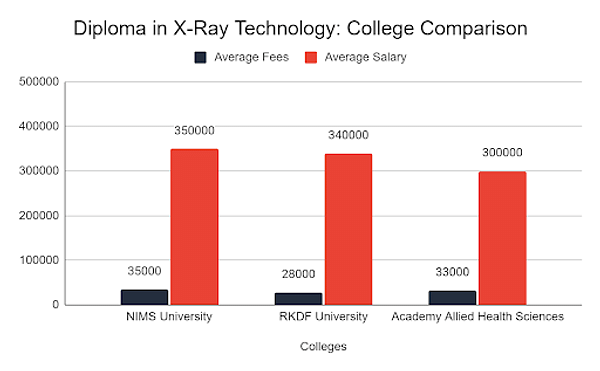
Diploma in X-Ray Technology: College Comparison
| Parameter | NIMS University | RKDF University | Academy Allied Health Sciences |
|---|---|---|---|
| Objective | It is a private university, it offers the UG,PG,Diploma etc. | It is a private university. This college offers UG,PG, Diploma, Pharmacy etc. | This institute offers the diploma and certification course. |
| Location | Jaipur | Bhopal | Kolkata |
| Eligibility | 10+2 with PCB/PCM or posses an equivalent qualification from a recognized board | 10+2 in science (PCB) with 40% marks(UR category) and 35% marks(reserved category) | 10+2 with science by CBSE board or any equivalent exam conducted by any state board. |
| Average annual fee | INR 35,000 | INR 28,000 | INR 33,000 |
| Average Salary | INR 3.5 LPA | INR 3.4 LPA | INR 3 LPA |
Diploma in X-Ray Technology: Course Comparison
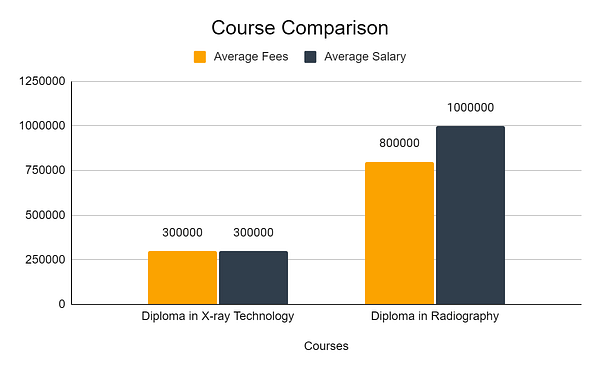
The course comparison between Diploma in X-ray Technology and Diploma in Radiography is given below :
| Parameters | Diploma in X-ray Technology | Diploma in Radiography |
|---|---|---|
| Duration | 2 years | 3 years |
| Course Level | Diploma | Diploma |
| Examination Type | Semester | Semester |
| Eligibility | 10+2 | 10+2 examinations |
| Admission Process | Entrance-exam based / Merit-based | Entrance-exam based / Merit-based |
| Course Fee | Between INR 2 to 3 LPA | Between 10,000 to 8,00,000 |
| Average Starting Salary | INR 3,00,000 | Between INR 1 to 10 LPA |
| Top Recruiting Organizations | Hospitals, Clinics, Medical labs, Govt. labs, Govt. Hospitals etc. | Global medical Recruiting, St. Joseph Hospital, HITECH Diagnostics etc. |
| Top Recruiting Areas | Doctor’s Office, Private clinics, Outpatient Care, Medical content writing, colleges and universities etc. | Private Care centers, Occupational Health centers, Radiotherapy Equipment manufacturers, Radiotherapy Research organizations etc. |
| Job Positions | X-ray technician, Assistant X-ray technician, Consultant Radiologist, Teacher etc. | X-ray technician, Diagnostic radiographer, Radiation Therapy Technologist, Radiation Protection Specialist, Therapy radiographer etc. |
Diploma in X-Ray Technology: Job Profiles
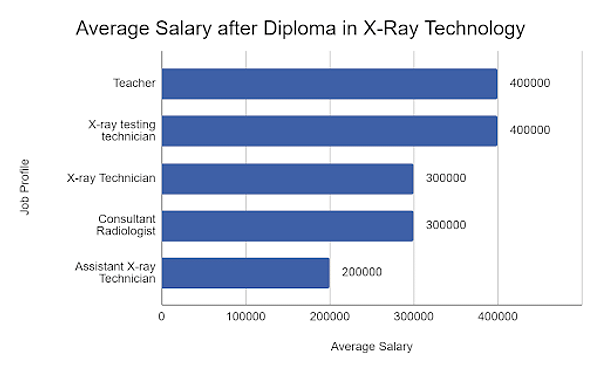
X-ray technology graduate diploma career options and job prospects are monstrous and continue to grow with the rapid expansion of the healthcare industry. Some of the most common job profiles that a Diploma in X-ray Technology student can opt for along with job description and salary package are mentioned in the table below :
| Job Profile | Job Description | Average Annual Salary |
|---|---|---|
| X-ray Technician | Technologists manage efficiently and read and receive diagnostic reports using technical components and machines | INR 2 to 3 LPA |
| Assistant X-ray Technician | The assistant X-ray technician is able to operate the X-ray or radiographic machine | INR 1 to 2 LPA |
| Consultant Radiologist | Patients are advised to make proper diagnosis and treatment and also to get proper type of testing is suggestions | INR 2 to 3 LPA |
| Teacher | Instructor who will teach all the ideas and methods for other able candidates | INR 3 to 4 LPA |
| X-ray testing technician | X-ray testing technicians can handle all of these types of components and test options | INR 3 to 4 LPA |
Diploma in X-Ray Technology: Future Scope
After completing the diploma in X-ray technology the students can pursue a higher degree in their career. There are several courses applicable for a diploma in X-ray technology graduates, some of which include:
- B.Sc in Radiology: If one wants to continue in the same field of education, the first program of choice is B.Sc. in Radiology. It is a 3 years course and the eligibility criteria include having a 10+2 with 50% in science stream of an approved board.
- B.Sc in Radiography Imaging Techniques: It is a 3 years undergraduate degree. The eligibility criteria include having a 10+2 science stream from a recognized board.
- B.Sc Medical Lab Technology: It is a 3 years undergraduate course degree. The eligibility criteria include having a 10+2 with 50% in the science stream from a recognized board. The admission process is entrance-based and merit-based.
- B.Sc in Radiotherapy: It is a 3 years undergraduate course degree. The eligibility criteria include having a 10+2 with science stream from a recognized board. The admission process is either direct admission or entrance-examination process.
Diploma in X-Ray Technology Admission Procedure
The admission process for the Diploma in X-Ray Technology Course in most of the colleges is carried over by considering the merit score in class 12th exams. Some institutions take into account the marks obtained by candidates during entrance exams. Additionally, they may carry out a personal interview to check if the candidate has the required skills to pursue this course.
Candidates will be called to participate in a college-level entrance test. After clearing the exam, they will receive a call to take part in other selection processes. The concerned college or institution will then release a merit list containing candidates’ names, their rank, and score. The colleges will offer admissions to interested candidates based on their score or rank, and seats available under the individual choices.
Diploma in X-Ray Technology Eligibility Criteria
All aspirants must have cleared the class 12 board examinations in the stream of science from a recognised board of education such as CBSE, ICSE, State Board or equivalent.
Candidates should have secured a minimum aggregate score of 45% or more in subjects such as Physics, Chemistry and Mathematics or Biology.
Admissions will be based on the basis of a University-level entrance test, therefore, candidates must appear for the specified entrance exam, as per the guidelines of the chosen college. Some colleges also accept admissions purely on merit-basis alone.
Nised board or meet the following prerequisites. To be admitted to the Diploma in X-Ray Technology programme, students must pass the 10+2 boards Examination in science stream, from a recognised board.
Entrance Exam Based Admission
- Cautious candidates will be invited to take part in the university-level entrance examination.
- The concerned universities/ colleges will publish the names of the candidates and their merit list along with the examination scores.
- After clearing the entrance exam the candidates will be invited for their personal interview round.
- The respective colleges / universities will give admission opportunities to the potential students on the basis of the entrance test including the overall performance.
Merit Based Admission.
The candidates can apply to Diploma in X-ray Technology colleges providing admission to this course. The candidates must follow the admission rules while applying to colleges.
- The interested candidates will be asked to appear for the selection process as described by the colleges/ universities.
- The candidates visit the official website of the institute for the admission application form.
- The careful applicants fill the application form with correct details and upload the required documents in the ethical dimensions.
- After completing the application form, the final selections will be done on the basis of interview and group discussions.
Diploma In X-Ray Technology: How To Prepare For Entrance Exams?
Tregulation for various diploma courses (2 years) in paramedical subjects.
The objective of the courses
1. The training of the candidate registering for various diploma (2 years)courses are aimed to carry out all routine diagnostic / therapeutic test on modern hospital laboratory
2. The Diploma course is of two years
3. Eligibility for admission in all para medical diploma courses except percussionist a) the candidate must have passed 10+2 with at least 40% marks in aggregate of physics chemistry and biology (p c b ) and for DMLT 10 + 2 ( p c b ) or 10 + 2 vocational (m l t )course with at least 40% marks will also be eligible b) for diploma in perfusion technology (percussionist 2 years course) the candidate shall have passed b. Sc. (biology group) with minimum 45% marks, the university will award p g diploma in perfusion technology
4. In case of SC/ST/OBC candidates, 5% marks relaxation will be given for the admission in above said courses
5. Weight age will be given as per university rules
6. Number of seats will be 50 in each course
7. The minimum age for admission shell be 17 years on 31 December of the Academic year of admission
8. The selection of candidate will be on the basis of the entrance examination or in the absence of entrance exam, purely on merit list prepared on the basic of marks obtained in qualifying examination
9. The admissions of students into various programs should be completed by 30th November. There shall be minimum 240 teaching days in one academic year.
10. Attendance of students: The student should have 75% attendance in theory and 75% attendance in practical to be eligible to appear in university examination. However, only Dean/ Principal of the college are empowered to condone 10% of attendance on valid grounds. Monthly attendance of students has to be sent to the university every month from the respective affiliated colleges.(*MPMSU)
11. Total Course Duration: A student has to complete the course that he/she has joined with in the double the duration of the actual time taken for the completion of the course i.e.- Four Years for all Diploma Courses.
12. Medium of instruction and examination: In case of diploma courses the medium of instruction will be bilingual (English or Hindi) and the medium of examination will be either English or Hindi as per the convenience of the student.
13. There will be two University Examinations in one academic session.
14. For all the Diploma courses (which is of two years duration) at the end of first year, an Internal examination will be conducted at the college level itself and the result has to be sent to the University as per the scheduled notification. (These marks will be included in the Final Transcripts), and the students are eligible to appear their final year examination at MPMSU, subject to passing in first year internal examination conducted at college level. University examination will be held at the end of Two years only.
15. Passing marks of examination: • the passing marks of examination would be 50% for each subject and also in total marks obtained for both diploma and degree courses. The candidate has to pass in theory and practical examination separately. For theory paper the internal assessment marks, viva-voce and theory examination marks will be counted. • The candidate should pass separately in two heads i.e. in theory (theory plus viva voce plus internal assessment) and also in practical (with 50% marks). • The candidate has to pass separately in each subject in internal assessment examination (with 50% marks) in order to be eligible to appear in university examinations. • regarding grace marks it was decided that total weightage of grace marks would be 5 (five), and that grace marks can be split between the subjects. There will not be any grace marks for the practical examination. • Grace marks will not be added to total marks of the candidate. In supplementary examination also similar pattern of grace marks will be followed.
16. Re-totaling & Re-valuation (Review) both should be allowed as per the university rules
17. Other rules regarding conduct of examination will be as per the university REGULATION/notifications
18. Permission will be given to start the courses after the permission from M P Paramedical council (Department of Medical education, Government of M. P.)
19. Syllabus and scheme of examination shall be decided by the board of studies and Academic council of the university from time to time as per guidelines from M P Paramedical council
20. In order to be an examiner a faculty member should have minimum three years of teaching experience and not below the rank of the Assit. Professor and /or. Demonstrator / Tutor
21. The examination papers (Theory) will be evaluated centrally at the university
22. The examiner who evaluates the theory copy preferably be appointed as the external for practical examinations for the said course.
23. Diploma students will be eligible for supplementary examination.
INSTRUCTIONS FOR THE CANDIDATES:
Answer all questions only in required word. There will be only 1 single answer sheet containing 40 pages and no additional sheets would be provided to the studen
Diploma in X-Ray Technology Admission Procedure
The admission process for the Diploma in X-Ray Technology Course in most of the colleges is carried over by considering the merit score in class 12th exams. Some institutions take into account the marks obtained by candidates during entrance exams. Additionally, they may carry out a personal interview to check if the candidate has the required skills to pursue this course.
Candidates will be called to participate in a college-level entrance test. After clearing the exam, they will receive a call to take part in other selection processes. The concerned college or institution will then release a merit list containing candidates’ names, their rank, and score. The colleges will offer admissions to interested candidates based on their score or rank, and seats available under the individual choices.
Diploma in X-Ray Technology Eligibility Criteria
All aspirants must have cleared the class 12 board examinations in the stream of science from a recognised board of education such as CBSE, ICSE, State Board or equivalent.
Candidates should have secured a minimum aggregate score of 45% or more in subjects such as Physics, Chemistry and Mathematics or Biology.
Admissions will be based on the basis of a University-level entrance test, therefore, candidates must appear for the specified entrance exam, as per the guidelines of the chosen college. Some colleges also accept admissions purely on merit-basis alone.
Nised board or meet the following prerequisites. To be admitted to the Diploma in X-Ray Technology programme, students must pass the 10+2 boards Examination in science stream, from a recognised board.
Entrance Exam Based Admission
- Cautious candidates will be invited to take part in the university-level entrance examination.
- The concerned universities/ colleges will publish the names of the candidates and their merit list along with the examination scores.
- After clearing the entrance exam the candidates will be invited for their personal interview round.
- The respective colleges / universities will give admission opportunities to the potential students on the basis of the entrance test including the overall performance.
Merit Based Admission.
The candidates can apply to Diploma in X-ray Technology colleges providing admission to this course. The candidates must follow the admission rules while applying to colleges.
- The interested candidates will be asked to appear for the selection process as described by the colleges/ universities.
- The candidates visit the official website of the institute for the admission application form.
- The careful applicants fill the application form with correct details and upload the required documents in the ethical dimensions.
- After completing the application form, the final selections will be done on the basis of interview and group discussions.
Diploma In X-Ray Technology: How To Prepare For Entrance Exams?
Tregulation for various diploma courses (2 years) in paramedical subjects.
The objective of the courses
1. The training of the candidate registering for various diploma (2 years)courses are aimed to carry out all routine diagnostic / therapeutic test on modern hospital laboratory
2. The Diploma course is of two years
3. Eligibility for admission in all para medical diploma courses except percussionist a) the candidate must have passed 10+2 with at least 40% marks in aggregate of physics chemistry and biology (p c b ) and for DMLT 10 + 2 ( p c b ) or 10 + 2 vocational (m l t )course with at least 40% marks will also be eligible b) for diploma in perfusion technology (percussionist 2 years course) the candidate shall have passed b. Sc. (biology group) with minimum 45% marks, the university will award p g diploma in perfusion technology
4. In case of SC/ST/OBC candidates, 5% marks relaxation will be given for the admission in above said courses
5. Weight age will be given as per university rules
6. Number of seats will be 50 in each course
7. The minimum age for admission shell be 17 years on 31 December of the Academic year of admission
8. The selection of candidate will be on the basis of the entrance examination or in the absence of entrance exam, purely on merit list prepared on the basic of marks obtained in qualifying examination
9. The admissions of students into various programs should be completed by 30th November. There shall be minimum 240 teaching days in one academic year.
10. Attendance of students: The student should have 75% attendance in theory and 75% attendance in practical to be eligible to appear in university examination. However, only Dean/ Principal of the college are empowered to condone 10% of attendance on valid grounds. Monthly attendance of students has to be sent to the university every month from the respective affiliated colleges.(*MPMSU)
11. Total Course Duration: A student has to complete the course that he/she has joined with in the double the duration of the actual time taken for the completion of the course i.e.- Four Years for all Diploma Courses.
12. Medium of instruction and examination: In case of diploma courses the medium of instruction will be bilingual (English or Hindi) and the medium of examination will be either English or Hindi as per the convenience of the student.
13. There will be two University Examinations in one academic session.
14. For all the Diploma courses (which is of two years duration) at the end of first year, an Internal examination will be conducted at the college level itself and the result has to be sent to the University as per the scheduled notification. (These marks will be included in the Final Transcripts), and the students are eligible to appear their final year examination at MPMSU, subject to passing in first year internal examination conducted at college level. University examination will be held at the end of Two years only.
15. Passing marks of examination: • the passing marks of examination would be 50% for each subject and also in total marks obtained for both diploma and degree courses. The candidate has to pass in theory and practical examination separately. For theory paper the internal assessment marks, viva-voce and theory examination marks will be counted. • The candidate should pass separately in two heads i.e. in theory (theory plus viva voce plus internal assessment) and also in practical (with 50% marks). • The candidate has to pass separately in each subject in internal assessment examination (with 50% marks) in order to be eligible to appear in university examinations. • regarding grace marks it was decided that total weightage of grace marks would be 5 (five), and that grace marks can be split between the subjects. There will not be any grace marks for the practical examination. • Grace marks will not be added to total marks of the candidate. In supplementary examination also similar pattern of grace marks will be followed.
16. Re-totaling & Re-valuation (Review) both should be allowed as per the university rules
17. Other rules regarding conduct of examination will be as per the university REGULATION/notifications
18. Permission will be given to start the courses after the permission from M P Paramedical council (Department of Medical education, Government of M. P.)
19. Syllabus and scheme of examination shall be decided by the board of studies and Academic council of the university from time to time as per guidelines from M P Paramedical council
20. In order to be an examiner a faculty member should have minimum three years of teaching experience and not below the rank of the Assit. Professor and /or. Demonstrator / Tutor
21. The examination papers (Theory) will be evaluated centrally at the university
22. The examiner who evaluates the theory copy preferably be appointed as the external for practical examinations for the said course.
23. Diploma students will be eligible for supplementary examination.
INSTRUCTIONS FOR THE CANDIDATES:
Answer all questions only in required word. There will be only 1 single answer sheet containing 40 pages and no additional sheets would be provided to the studen