MASTER DIGREE IN YOGA
What is Yoga?
Yoga, in the simplest of terms, is an activity that enables a person in connecting with his or her spiritual, mental, and physical, being with utmost focus and concentration. With pursuing yoga courses, candidates can primarily learn physical exercise and implicate movement of body parts in a way that channelizes certain holistic health benefits.
Along with this, yoga course also helps to learn about healthy practices like regulating breathing through various techniques, performing physical exercises, and relaxation habits for long-term well-being. The sole purpose of yoga is to combine all the senses in a particular direction and align them with the environment.
Yoga will not only be beneficial for physical or mental health, but also will enable you to make a promising career.
Yoga aims at eliminating these unhealthy practices and striking harmony in a person's life in such a way that both mind and body are prospered. All of this makes pursuing a career in Yoga a very feasible and secure option.
What is MA Yoga all About?
- The aim of the course is to provide yoga therapy to people suffering from psychosomatic disorders. People in today’s stressful world are becoming more and more health-conscious. As a result, the need for skilled and certified yoga professionals is also increasing day by day.
- Students pursuing this degree study the different ways and techniques of yoga therapy that may be applied in order to relax and prevent people from stressing out.
- The course also involved the study of healthy habits that are to be continued alongside the asanas to maintain health and benefit the body more.
- The course is suitable for students interested in increasing muscle strength, flexibility, losing weight, etc. People interested in preventing stress, anxiety and depression, enhancing sleep patterns, reducing blood pressure and the impact of heart diseases, etc are also benefited from this course.
- The curriculum is designed to provide in-depth knowledge and information and techniques about yoga and is mainly focused on the theoretical and practical aspects of the ancient discipline.
Why Should You Study MA Yoga?
Listed below are the reasons for students to continue their education in the field of yoga by pursuing a master’s degree in it.
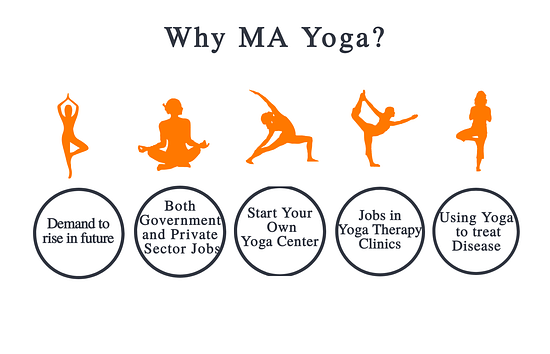
- Since the demand for yoga instructors and well-qualified yoga professionals has been growing by 30-35% every year, the number of yoga schools and certification academies has also increased. So, the demand for teachers and yoga instructors are expected to increase in future.
- The course is beneficial for experienced yoga instructors or health practitioners, including medical professionals who want to learn and use yoga techniques for the treatment of various diseases.
- Being skilled and certified in the practices of yoga gives students the opportunity to not only work on their career in India but easily take it abroad to establish a career there as well.
- Not only will students learn to help others through yoga, but also themselves by practising the art of yoga regularly and preventing diseases, and reducing stress, anxiety, depression, etc.
- The salary of a yoga professional can increase with the amount of experience they have gained. When they were first starting out with their professional studies - the salary may seem to be a disappointment, but it will increase with time.
Highlights
| Course Level | Post Graduate Degree |
| Full-Form | Master of Arts in Yoga |
| Duration | 2 years |
| Examination Type | Semester and Annual |
| Eligibility | Bachelor’s Degree, with a minimum score of 55% |
| Admission Process | Merit and Entrance Exam Based |
| Course Fee | INR 13,000 to INR 1,20,000 |
| Average Salary | INR 1,50,000 to INR 2,00,000 |
| Top Recruiting Companies | Government & Private Schools, Yoga and Naturopathy colleges or institutions. ESIC General Hospital Naroda Ahmedabad, Hyatt Hotels Corporation, Central Council for Research in Homoeopathy, Centre Research Centers, Resorts |
| Job Positions | Yoga Therapy Instructor, Gym Manager-cum-Instructor, Therapist, Yoga Trainer, Consultant Yoga Therapist, Panchakarma Therapist, Marketing Field Worker, Clinical Psychologist, Receptionist & Office Assistant, Teacher/Private Tutor, Customer Relationship Executive, Front Office Assistant, Customer Relationship Executive, etc. |
Benefits
- A career in Yoga offers a variety of benefits, including:
- The opportunity to help people improve their health and well-being
- A stable and secure job
- A good salary
- The chance to work in a variety of settings, including hospitals, clinics, and wellness centers
Syllabus
The syllabus for Master Degree in Yoga typically includes the following topics:
- History of Yoga
- Philosophy of Yoga
- Anatomy and Physiology of Yoga
- Yoga Psychology
- Yoga Therapy
- Yoga for Specific Populations
- Research Methods in Yoga
| First Year | Second Year |
|---|---|
| Basics of Yoga - Philosophy of Yoga | Perspectives in Consciousness - Jainism, Buddhism, Sufism, Christianity |
| Basics of Yoga II - Basic Sanskrit | Scientific Study of Yoga and Consciousness |
| Basic Human Anatomy and Physiology | Consciousness: Western & Interdisciplinary |
| Basic Psychological Processes and Disorders | Message of Upanishads |
| Consciousness & Yoga | Therapeutic Yoga Practice II |
| Theoretical Perspectives of Yoga | Advanced Techniques of Yoga |
| Health and Yoga | Patanjali Yoga Sutras and Shad Darshanas |
| Basic Research Methodology and Statistics | Traditions of Shramana Dhare |
| Applications of Yoga | Case Studies |
| Therapeutic Yoga Practice I | Dissertation |
MA Yoga Important Books
Books are the most important aspects of any course. We have tabulated some of the most important books for the MA Yoga course in the table given below.
| Name of the book | Author |
|---|---|
| The Wisdom of Yoga: A Seeker’s Guide to Extraordinary Living | Stephen Cope |
| Yoga: The Greater Tradition | David Frawley |
| Light on Yoga: The Bible of Modern Yoga | B.K.S. Iyengar |
| Yoga Anatomy | Leslie Kaminoff |
| The Heart of Yoga: Developing a Personal Practice | T.K.V. Desikachar |
| Yoga as Medicine | Timothy McCall |
| Yoga Sequencing: Designing Transformative Yoga Classes | Mark Stephens |
Fee
The fee for a Master Degree in Yoga varies depending on the institution. In India, the fee ranges from INR 5 lakhs to INR 20 lakhs.
Skills Required
The following skills are required for a career in Yoga:
- Strong communication skills
- Strong teaching skills
- Strong research skills
- Problem-solving skills
- Teamwork skills
Cut off
The cut off for admission to a Master Degree in Yoga varies depending on the institution. In India, the cut off is typically around 50% for general category students and 60% for reserved category students.
Specializations
There are a number of specializations available in Yoga, including:
- General Yoga
- Yoga Therapy
- Yoga for Specific Populations
Top Recruiters
Some of the top recruiters for Master Degree in Yoga graduates include:
- Government hospitals
- Private hospitals
- Wellness centers
- Yoga studios
- Pharmaceutical companies
Salary
The salary for a Master Degree in Yoga graduate varies depending on the specialization and the level of experience. In India, the average salary for a Master Degree in Yoga graduate is around INR 5 lakhs per year.
Job Profiles
Some of the job profiles available for Master Degree in Yoga graduates include:
- Yoga teacher
- Yoga therapist
- Yoga researcher
- Yoga product developer
- Yoga instructor
Career Opportunities and Job Prospects
- By earning a professional degree in Yoga, students get a direct pass to enter the world of fitness, and an entire world full of job opportunities.
- Students with a MA in Yoga not only have job opportunities in fitness but they can also work for the government under AYUSH.
The employment sectors for yoga professionals with a MA in Yoga are listed as follows:
- Government and Private Schools
- Yoga Colleges & Institutions
- Yoga Research Centers
- Hotels & Resorts
- Gym and Fitness Centers
- Health Club
Scope
- After pursuing MA Yoga, students have the opportunity to work at Health Clubs, Yoga & Pilates Studios, Special Needs Centres, Gyms and in individual clients homes.
- There are also various self-employment opportunities as students can establish their own Yoga Schools and Studios.
- Studying Yoga at a professional level also opens various job opportunities in the fields like Research, Management, Hospitals, Academics, Administration, Consultation, etc.
- The government has made it compulsory to have a yoga teacher in every school, so the demand for yoga professionals has also increased, hence, job opportunities are readily available.
- After pursuing their Master of Arts in Yoga, students can decide whether they are interested in pursuing a doctorate level degree in yoga (PHD Yoga).
- The PhD in Yoga is a three-year course, and to be eligible for this, students have to score a minimum of 55% in their master’s degree. Students will study yoga therapy in-depth to help those suffering from psychosomatic disorders. They will also learn how to treat patients with facilities available at hospitals and through yoga treatments.
Employment Areas
Master Degree in Yoga graduates can find employment in a variety of areas, including:
- Yoga
- Yoga therapy
- Yoga for Specific Populations
Top Colleges in India
Some of the top colleges in India for Master Degree in Yoga include:
- The Yoga Institute, Pune
- SVYASA Yoga University, Bangalore
- Patanjali Yogpeeth, Haridwar
- Krishnamacharya Yoga Mandiram, Chennai
- Bihar School of Yoga, Munger
MA Yoga Admission Process
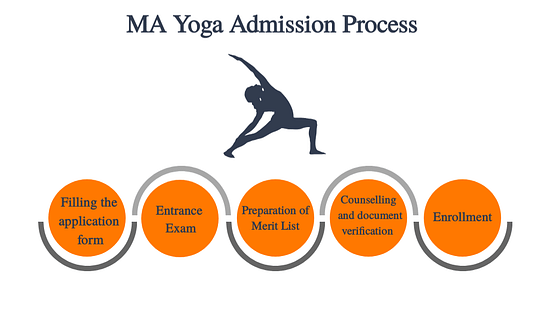
Students seeking admission in the top colleges of India that offer a MA in Yoga have a similar admission process, however, there may be some variants that are not addressed below. A common application process is given below, for both merit and entrance exam based admission.
Merit-Based Admissions
Following are the steps to get admission to a college like the Atal Bihari Vajpayee Hindi Vishwavidyalaya located in Bhopal that offers merit-based admissions.
- Fill and submit applications: The application should be filled up properly without any mistakes. Otherwise, it may get rejected.
- Upload documents: After filling out all the required details in the application form, students should scan and upload all the necessary documents for admission and verification on the admission portal.
- Review: The admissions team at the university will then review the students’ applications and see if they fit the eligibility and selection criteria. The shortlisted students will proceed to the interview round.
- Personal Interviews: Universities conduct personal interviews so that they can get an idea of the candidate’s nature and background in regards to the university’s selection criteria.
Entrance Exam Based Admission
The admission procedure to gain admission in a student’s desired university which shortlists students on the basis of entrance exams, like Bhubaneshwar’s Kalinga Institute of Industrial Technology is given below:
- Fill and submit application forms
- Upload the required documents
- Application Fee Payment
- Register for Entrance Exam: If the university that the student has applied to does not directly register the student for the entrance exam, it is the student’s responsibility to register well before the deadline.
- Writing Exams and Results: After the release of the examination dates by the conducting body, The admit cards will be released. Once the examination is over, the review process begins which is followed by the declaration of results.
- Personal Interviews: If the results of the entrance exam meet the university’s eligibility and selection criteria, those candidates will be invited for a personal interview either online or on campus.
How to get admission in top MA Yoga colleges?
The following points should be kept in mind if students are seeking admission in the top colleges of India that offer MA Yoga:
- Students should stay updated with the college’s recent press releases, notices and eligibility criteria, cut-off, application deadlines, processes, etc.
- Since the admission process can continue only if students meet the eligibility criteria, like 55%; it is absolutely necessary to score well in their bachelor’s degree exams.
- Students should start preparing for entrance exams as soon as possible so that they have more than enough time to polish their basic concepts. They should also keep a track of general knowledge while getting practice with the type of questions that will be asked.
- Make sure that applications are submitted on time or even early as it will give students plenty of time to get rid of the tension, and focus on entrance exam preparation.
Eligibility Criteria (UG & PG) Of Yoga
Mentioned Below Are The Eligibility Criteria For Yoga Course:
Eligibility Criteria For Undergraduate Yoga Courses
Eligibility Criteria For Postgraduate Yoga Courses
Some Private Universities Also Make It Mandatory For The Candidate To Appear For A Personal Interview After The Clearance Of The Entrance Examination.
State-level And National Level Entrance Exams Are Annually Held For Aspiring Candidates.
Must Have A Bachelor's Degree In The Required Line From A Recognized Institution With Atleast 50% Aggregate Marks.
Most Universities Do Not Conduct Entrance Examinations For Admission To Do A Bachelor's Degree In Yoga And Hence The Admission To Candidates Is Given Solely On A Merit Basis.
Some Universities Have Their Entrance Examination Which Candidates Have To Qualify And Reach The Minimum Cut Off Released Before The Commencement Of The Admission Procedure.
Successful Completion Of Class 12th From A Recognized Board With Any Stream With Minimum Aggregate Marks Of 40-50%.
Entrance Exam Based Admission
The Admission Procedure To Gain Admission In A Student’s Desired University Which Shortlists Students On The Basis Of Entrance Exams, Like Bhubaneshwar’s Kalinga Institute Of Industrial Technology is Given Below:
- Fill And Submit Application Forms
- Upload The Required Documents
- Application Fee Payment
- Register For Entrance Exam: If The University That The Student Has Applied To Does Not Directly Register The Student For The Entrance Exam, It Is The Student’s Responsibility To Register Well Before The Deadline.
- Writing Exams And Results: After The Release Of The Examination Dates By The Conducting Body, The Admit Cards Will Be Released. Once The Examination Is Over, The Review Process Begins Which Is Followed By The Declaration Of Results.
- Personal Interviews: If The Results Of The Entrance Exam Meet The University’s Eligibility And Selection Criteria, Those Candidates Will Be Invited For A Personal Interview Either Online Or On Campus.
How To Prepare For These Exams?
The Entrance Exams Are Usually MCQ Based. The Syllabus For The Exam Usually Comprises Subjects And Knowledge Areas Covered In The Graduate Level. The Syllabus Is According To The Regulations Of The Respective Discipline Issued By CCIM/CCHA (for The AIA PGET).
A List Of Points That Can Be Helpful For Students To Prepare For The Entrance Exams Conducted By The Government, And The Private Body (university) Are Given Below:
- Students Must Be thorough With The Examination Syllabus as They Can Prepare For The Exam Easily If They Are Well-versed With The Syllabus.
- Students Should Also Try To attempt As Many Past Question Papers as They Can So That They Can Achieve A Better Understanding Of The Exam Pattern And The Type Of Questions That Will Be Asked.
- Learning How To manage Time Is One Of The Most Important Things That Students Should Invest Their Time In Because They Will Have To Answer 100 Questions In The Span Of Ninety Minutes.
- Students Should not Refer To More Than One Book As A Reference Because If They Take Help From Multiple Books And Need To Find Just One Concept - It Wastes Time.
- Students Should Stay Fit And Healthy While Preparing For Exams Instead Of Stressing Themselves Out And Wasting Time By Doing That.
- Make A Proper Timetable So That Time Can Be Allocated Easily, And Almost Equally For Normal Everyday Life, And Exam Preparation.
- It Is Extremely Important For Students To Be familiar With The Marking Scheme as It Will Help Them Decide Which Questions To Leave If In A Rush, As Well As The Negative Marking Scheme.
MA Yoga Admission Process
Students seeking admission in the top colleges of India that offer a MA in Yoga have a similar admission process, however, there may be some variants that are not addressed below. A common application process is given below, for both merit and entrance exam based admission.
Merit-Based Admissions
Following are the steps to get admission to a college like the Atal Bihari Vajpayee Hindi Vishwavidyalaya located in Bhopal that offers merit-based admissions.
- Fill and submit applications: The application should be filled up properly without any mistakes. Otherwise, it may get rejected.
- Upload documents: After filling out all the required details in the application form, students should scan and upload all the necessary documents for admission and verification on the admission portal.
- Review: The admissions team at the university will then review the students’ applications and see if they fit the eligibility and selection criteria. The shortlisted students will proceed to the interview round.
- Personal Interviews: Universities conduct personal interviews so that they can get an idea of the candidate’s nature and background in regards to the university’s selection criteria.
Entrance Exam Based Admission
The admission procedure to gain admission in a student’s desired university which shortlists students on the basis of entrance exams, like Bhubaneshwar’s Kalinga Institute of Industrial Technology is given below:
- Fill and submit application forms
- Upload the required documents
- Application Fee Payment
- Register for Entrance Exam: If the university that the student has applied to does not directly register the student for the entrance exam, it is the student’s responsibility to register well before the deadline.
- Writing Exams and Results: After the release of the examination dates by the conducting body, The admit cards will be released. Once the examination is over, the review process begins which is followed by the declaration of results.
- Personal Interviews: If the results of the entrance exam meet the university’s eligibility and selection criteria, those candidates will be invited for a personal interview either online or on campus.
How to get admission in top MA Yoga colleges?
The following points should be kept in mind if students are seeking admission in the top colleges of India that offer MA Yoga:
- Students should stay updated with the college’s recent press releases, notices and eligibility criteria, cut-off, application deadlines, processes, etc.
- Since the admission process can continue only if students meet the eligibility criteria, like 55%; it is absolutely necessary to score well in their bachelor’s degree exams.
- Students should start preparing for entrance exams as soon as possible so that they have more than enough time to polish their basic concepts. They should also keep a track of general knowledge while getting practice with the type of questions that will be asked.
- Make sure that applications are submitted on time or even early as it will give students plenty of time to get rid of the tension, and focus on entrance exam preparation.
Eligibility Criteria (UG & PG) Of Yoga
Mentioned Below Are The Eligibility Criteria For Yoga Course:
Eligibility Criteria For Undergraduate Yoga Courses
Eligibility Criteria For Postgraduate Yoga Courses
Some Private Universities Also Make It Mandatory For The Candidate To Appear For A Personal Interview After The Clearance Of The Entrance Examination.
State-level And National Level Entrance Exams Are Annually Held For Aspiring Candidates.
Must Have A Bachelor's Degree In The Required Line From A Recognized Institution With Atleast 50% Aggregate Marks.
Most Universities Do Not Conduct Entrance Examinations For Admission To Do A Bachelor's Degree In Yoga And Hence The Admission To Candidates Is Given Solely On A Merit Basis.
Some Universities Have Their Entrance Examination Which Candidates Have To Qualify And Reach The Minimum Cut Off Released Before The Commencement Of The Admission Procedure.
Successful Completion Of Class 12th From A Recognized Board With Any Stream With Minimum Aggregate Marks Of 40-50%.
Entrance Exam Based Admission
The Admission Procedure To Gain Admission In A Student’s Desired University Which Shortlists Students On The Basis Of Entrance Exams, Like Bhubaneshwar’s Kalinga Institute Of Industrial Technology is Given Below:
- Fill And Submit Application Forms
- Upload The Required Documents
- Application Fee Payment
- Register For Entrance Exam: If The University That The Student Has Applied To Does Not Directly Register The Student For The Entrance Exam, It Is The Student’s Responsibility To Register Well Before The Deadline.
- Writing Exams And Results: After The Release Of The Examination Dates By The Conducting Body, The Admit Cards Will Be Released. Once The Examination Is Over, The Review Process Begins Which Is Followed By The Declaration Of Results.
- Personal Interviews: If The Results Of The Entrance Exam Meet The University’s Eligibility And Selection Criteria, Those Candidates Will Be Invited For A Personal Interview Either Online Or On Campus.
How To Prepare For These Exams?
The Entrance Exams Are Usually MCQ Based. The Syllabus For The Exam Usually Comprises Subjects And Knowledge Areas Covered In The Graduate Level. The Syllabus Is According To The Regulations Of The Respective Discipline Issued By CCIM/CCHA (for The AIA PGET).
A List Of Points That Can Be Helpful For Students To Prepare For The Entrance Exams Conducted By The Government, And The Private Body (university) Are Given Below:
- Students Must Be thorough With The Examination Syllabus as They Can Prepare For The Exam Easily If They Are Well-versed With The Syllabus.
- Students Should Also Try To attempt As Many Past Question Papers as They Can So That They Can Achieve A Better Understanding Of The Exam Pattern And The Type Of Questions That Will Be Asked.
- Learning How To manage Time Is One Of The Most Important Things That Students Should Invest Their Time In Because They Will Have To Answer 100 Questions In The Span Of Ninety Minutes.
- Students Should not Refer To More Than One Book As A Reference Because If They Take Help From Multiple Books And Need To Find Just One Concept - It Wastes Time.
- Students Should Stay Fit And Healthy While Preparing For Exams Instead Of Stressing Themselves Out And Wasting Time By Doing That.
- Make A Proper Timetable So That Time Can Be Allocated Easily, And Almost Equally For Normal Everyday Life, And Exam Preparation.
- It Is Extremely Important For Students To Be familiar With The Marking Scheme as It Will Help Them Decide Which Questions To Leave If In A Rush, As Well As The Negative Marking Scheme.